Tuesday, February 28, 2017

Birding Arctic Norway

Day 1:
I arrived at Kirkenes airport in northern Norway on Thursday after a long journey from Zurich via Oslo. I had bought a book about birding in the Varanger area. The next morning, after picking up the rental car, I travelled to the Pasvik valley, south of Kirkenes, in the Taiga. It was about -14° C as we drove along the icy road toward our hotel.

As we passed an open area with tall birches, I spotted a bird at the top of one of them. Pulling over at the side of the road, I quickly identified it as a Northern Hawk Owl, the first lifer of the trip. It didn't seem bothered by the car at all, so I got out, crossed the road and started taking pictures. Because of the temperature, the owl's feathers were puffed up, making it look comically fat. It was one of the birds I wanted to see most on the trip, so I was excited.

Northern Hawk Owl
I then checked in at the Birk Husky B&B, a hotel recommended in the book. It had bird feeders, meaning I could look for Taiga species there. Unfortunately, none of the species I had hoped for showed, but I did go on a husky tour in the evening, which was a lot of fun.

Day 2:
I headed toward my next destination, the town of Vadso on the Varanger fjord. On the way I enjoyed seeing many reindeer, which despite being wild, are herded and slaughtered by the Sami people each fall, so some are marked with collars or colored markings. The pictures are from the way back to Kirkenes, where I stopped to photograph them.

Reindeer
Reindeer 
Reindeer
Reindeer
I stopped in Nesseby, a town with a beautiful church on the water, where I photographed Purple Sandpipers on the beach, a species that proved to be very common on the Varanger coast. 
Nesseby church
Purple sandpiper

After arriving in Vadso, I immediately went into the harbor and saw my first Steller's Eiders, a stunning duck that was common in Vadso, but extremely rare in Europe as a whole, with almost all of the population wintering in and around the Varanger fjord and breeding in the Russian tundra. There were about six close-by in the harbor and many more farther out in tight rafts. Other than that, there were many Long-tailed ducks in the harbor, a common bird which I saw at almost every location from then on.


Steller's Eiders
Steller's Eider
Steller's Eider


Day 3:

The next day, I planned to go to Vardo, stopping in Kiberg on the way. Before that, I went to Vadso harbor again. There was much better light for photographing the Steller's eiders, but they weren't quite as close as the day before. It was low tide, so many Purple sandpipers fed on the exposed rocks.

Hooded Crow - Hooded crows seem to be the most common bird in Varanger.
Steller's eider
Steller's eider
Steller's eider
Steller's eider
Steller's eider
Steller's and Common eider
Steller's eider
Steller's eider
Steller's eider 
Purple sandpiper 
I then started my journey east toward Vardo, and barely five minutes outside of Vadso, a huge White-tailed Sea Eagle flew past, cruising along the coast the opposite way of the car. I only saw my third lifer of the trip for a few seconds, but it was a majestic and awe-inspiring sight. According to the book, sea eagles were once rare in Varanger but have made a come-back recently, although they are more common in summer than winter and that was the only sighting of this species during the trip.


In Kiberg I saw the first Glaucous gulls of the trip and of my life, although they were far away and difficult to identify certainly as Glaucous rather than Iceland gulls, which are also found here, but in smaller numbers. I also saw other species I had seen earlier in Vadso such as Common and Steller's eiders, and a group of long-tailed ducks close to shore.
Long-tailed Duck
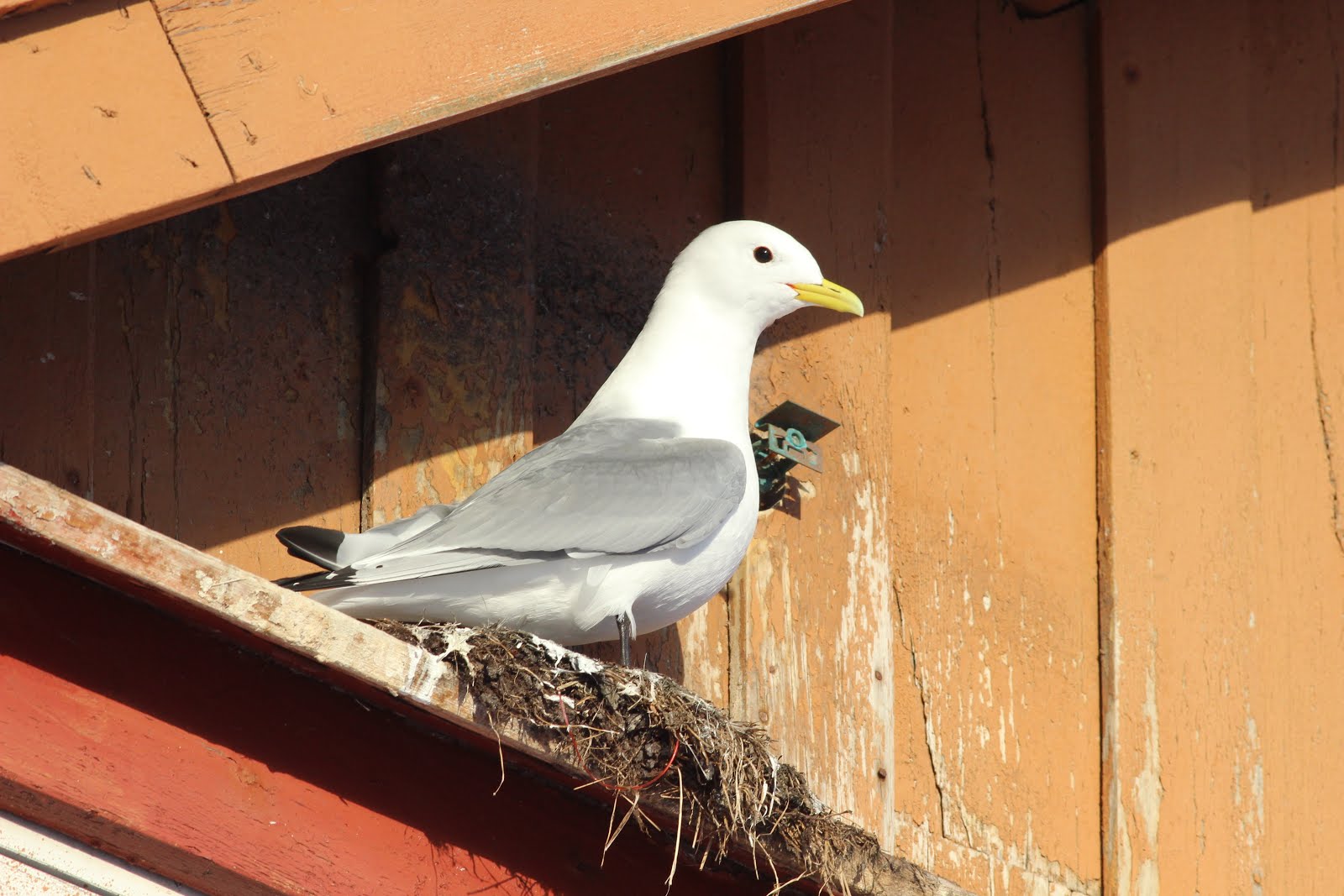
Continuing on to Vardo, I was surprised to find out that you had to pass through a tunnel to get to Vardo. It's a very cool experience going through the tunnel. When I arrived in the town, I started walking around Vardo harbor, much bigger than the one in Vadso. The first thing I saw was a European shag and a Glaucous gull on a small floating pier. To my surprise, the kittiwakes were already breeding and in breeding plumage. They breed on harborfront houses in Vardo, but in much smaller numbers than on the island of Hornoya, where the nesting seabirds are a true spectacle. Nevertheless, the kittiwakes were fun to watch and great photo subjects, especially when they opened their bills to reveal bright red coloring inside.
European shag and Glaucous gull 
Black-legged Kittiwakes
Black-legged Kittiwake
Black-legged Kittiwakes
On the other side of the harbor I finally found my first King eider of the trip, a female sitting on a rock alone. I expected these to be a lot more common, and this was the only good view I ever got. At the end of the harbor I saw my first Iceland gull of the trip, easy to identify next to two Glaucous gulls. The snow was falling rapidly at this point, creating cool pictures.
King (Queen) Eider

Purple sandpipers

Gulls in order from left to right: 1st year glaucous, 2 adult glaucous, 1st year Iceland
Iceland Gull
Iceland Gull
Glaucous gulls
Glaucous gulls

Common eider raft

The last stop in Vardo was Hasselnes, a spot overlooking the island of Hornoya, a breeding ground for many seabirds. Unfortunately, the ferry does not operate operate until March. From the hide I saw King eiders, including males, Black guillemots, Common and probably Thick-billed murres, and a Gray Seal.

Black guillemot
Black guillemot
Gray seal
Iceland gull and Vardo harbor
Day 4:
The next day I had a flight to Oslo in the morning, so I had to get up early to go to Vadsoya, an island in Vadso near my hotel where there were Mountain hare according to the book. Sure enough, I saw five or six hare altogether, all fully white and blending in with the snow. I also saw a flock of Snow buntings, probably early arrivals since according to the book they migrate through in March and don't winter.
Mountain hare
Mountain hare
Mountain hare
Mountain hares
Mountain hares
Overall, the trip was very successful, and I hope to visit Varanger again.

Saturday, January 28, 2017

Pine Bunting in Riazzino

Pine buntings are Siberian birds and are extremely rare in Switzerland, however during the past few weeks 1 to 4 individuals have been reported every day from the small town of Riazzino. The town is near Locarno in Ticino, the Italian-speaking part of Switzerland.

I took the train from Rotkreuz near my home to Bellinzona through the new Gotthard tunnel, the longest train tunnel in the world, and then took a small regional train to Riazzino. It was a 10-minute walk to the location the Pine Buntings had been reported and as soon as I got there I saw a large flock consisting of Tree sparrows, Yellowhammers and a few Reed buntings. The flock was scattered across an area of trees and shrubs on either side of a stream. Every now and then, the whole flock would fly across a field before scattering into the trees, meaning I had to start from scratch every time. I knew it would not be easy to find a Pine Bunting in these conditions.

After searching for around a half hour I started to give up on finding the Pine buntings. I had seen so many sparrows and yellowhammers that I thought I had seen every bird in the flock. It was getting cold and my camera was getting heavy, so I decided to go back to the station. Just as I was about to turn, though, I lifted my binoculars one last time at a bunting in a tree. I knew immediately it was an adult male Pine bunting, a striking and beautiful bird. I only saw it for a few seconds, but I was satisfied.

After a while, I saw the Pine bunting again and I was able to take some pictures. The best of the pictures was still not very good, but it was enough to be certain of my identification. Later I saw a Pine bunting through another birder's scope, which really revealed the beauty of this species with its chestnut head and white cheeks. The females are far more dull, and look like yellowhammers without the yellow.

Other than the bunting, I noticed that European robins and Hooded crows were far more abundant in this canton, the latter of which is nearly unheard of where I live.

Pine Bunting - 28-01-2017

Sunday, January 22, 2017

North Norfolk

I have to warn you. This post contains no pictures. The reason for this is that, being stupid,  I forgot to bring my camera charger on the trip so I couldn't take any pictures. It does, however, contain a few shots taken with my phone, not of birds but of landscapes.

I flew to London Stansted on Friday, and drove up to King's Lynn in Norfolk. The next morning, I set out to see two Glaucous gulls that had been reported from Sheringham, which I failed to locate. However, I did see a flock of incredibly tame Ruddy turnstones on the boardwalk in the town, eating bread thrown by humans along with starlings, pigeons and gulls.

I was more successful at my next stop, Titchwell Marsh, an RSPB reserve. I observed Bar-tailed and Black-tailed godwits, Dunlins, Sanderlings, oystercatchers, two Pied avocets, Black-bellied plovers and a Common ringed plover.

On Sunday I headed to Snettisham to try and witness the famous spectacle of thousands of Pink-footed Geese at dawn leaving an enormous mudflat called the Wash to reach sugar beet fields inland. I arrived a little late, but I still saw many Pink-footed Geese flying in formation and calling loudly. I also saw large numbers of various shorebirds, pheasants, a hare and even a weasel of some sort. Although shorebirds are much more impressive at low tide, the Wash itself is impressive at high tide, as it is a truly colossal area with river-like stretches of water running through its entirety.

Snettisham RSPB - 22/01/2017
 The Wash at Snettisham RSPB - 21/01/2017

Snettisham RSPB - 22/01/2017 - If you look closely there is a pheasant in this picture.


Wednesday, January 11, 2017

Goose trio

Three geese, two Tundra Bean geese and a Greater white-fronted goose, have been reported from the Baldeggersee in Canton Luzern in the past few days. The lake is only half an hour from my house, so naturally I decided to try my luck. I visited the location twice in a row because the first time I forgot to charge my camera, leaving me with blurry shots taken with my phone through my binoculars. These species are rare but more than annual in Switzerland, but I had never seen a Bean goose before.

The first time I went, the two Bean geese were alone in a field and I didn't see the white-fronted but the second time both species were mixed in with a large flock of Greylag geese.

Greater White-fronted Goose - 08/01/2017
Greater White-fronted Goose - 08/01/2017
Bean Goose - 08/01/2017
Bean Geese - 08/01/2017


Monday, January 2, 2017

Red-headed Woodpecker

Today I visited Hendrickson Park in Valley Stream, Nassau County to twitch the long-staying Pink-footed Goose. Although I dipped the goose, I did see the continuing Red-headed Woodpecker, which, according to eBird reports, had not strayed from the area around a yellow house in the park.

The woodpecker, my first lifer of 2017, was in subadult plumage so its head was not fully red, but still an impressive bird. This individual was slightly aggressive, chasing off many other birds in the area, including a Downy Woodpecker, House Sparrows and even Blue Jays. It was very active, generally flying between three trees in a triangle, often drumming and calling.

Red-headed Woodpecker - 02/01/2016

Red-headed Woodpecker - 02/01/2016

Red-headed Woodpecker - 02/01/2016


Sunday, January 1, 2017

Of Ross's Geese, King Eiders and Birding in Circles

Happy New Year!

This past week I saw three lifers at two locations. On Wednesday I visited Robert Moses State Park to twitch the long-staying pair of Ross's Geese in a traffic circle. They were two small, pure-white geese in a flock of Canada Geese, so I picked them out immediately. The short bill with a blue base, rounded head, no 'grin patch', and small size made it clear that these were not Snow Geese. They showed little fear of me or cars and were not nervous around me, feeding on grass without looking up at me once. They did look up however when two deer, common at Robert Moses, ran into the circle. Click the photos to see them full size.

Ross's Geese - 28/12/2016
I then continued on to Field 5, where a Lapland Longspur has been reported in another traffic circle. In this grassy circle, there was a flock of Horned Larks and House Sparrows, and I quickly discovered the odd one out, another lifer. This one however was shy, and I scared it away a number of times while trying to get close for a photo.

Lapland Longspur - 28/12/2016

My next birding trip was not strictly speaking a twitch, although the species I saw have been reported in the past. I visited Orient Point County Park and as soon as I started looking around with my binoculars, I spotted three Harlequin Ducks, two females and an immature male. They swam out to open water from the rocks and then suddenly took off, with one trailing far behind the other two.

Harlequin Ducks - 31/12/2016

I walked toward the rocks and saw four Purple Sandpipers feeding together. They let me approach closely, and I got some great pictures.

Purple Sandpipers - 31/12/2016

After that, I decided to walk to the point, passing a flock of Red-breasted Mergansers and a Long-tailed Duck on the way. As I was approaching the point, I could make out a flock of Common Eiders. Oddly, there was also a large flock of American Wigeons that flew in from the west and joined some that were already there. After scrutinizing the eider flock carefully, I noticed one individual with a black bill and a different head shape than the other eiders. I had found a female King Eider! This was another lifer for me, and although my fingers were nearly frozen and the wind was whipping at my face, I was extremely happy.

King Eider - 31/12/2016